
 Watch on YouTube
Premieres 4 November 2026 at 6pm UK time
The Old Fox's Library · Episode 12
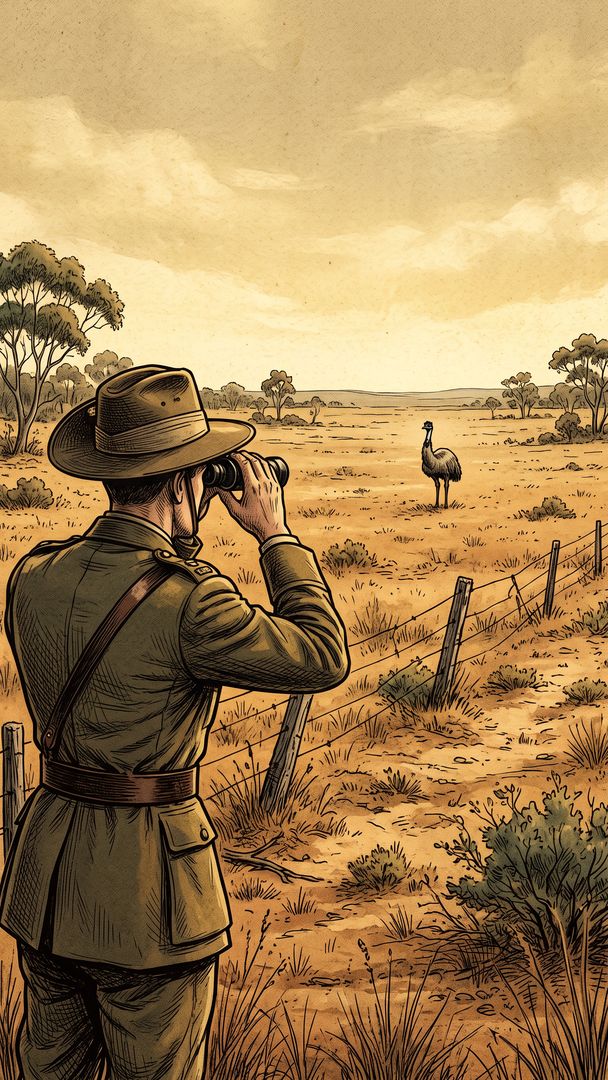
The Great Emu War of 1932
In 1932 wheat farmers in Western Australia asked for help against around 20,000 emus, and the army sent soldiers with two machine guns. The Old Fox tells how the birds ran rings around the plan, and what finally worked instead.
- In 1932 wheat farmers in the Campion district of Western Australia, many of them ex-servicemen settled there after the First World War, faced around 20,000 emus eating their crops and damaging fences (Australian Geographic).
- The Defence Minister, Sir George Pearce, sent Major G. P. W. Meredith of the Royal Australian Artillery with soldiers, two Lewis machine guns and 10,000 rounds of ammunition, starting on 2 November 1932 (Australian Geographic; Encyclopaedia Britannica).
- The emus scattered in small groups; in the first week around 2,500 rounds were fired and between about 50 and 200 emus killed, and the troops were withdrawn (Australian Geographic).
- After a second attempt ending on 10 December 1932, Meredith reported 986 emus killed with 9,860 rounds; historians consider these figures disputed (Encyclopaedia Britannica; Wikipedia).
- Meredith compared the birds' resilience to that of tanks, and in Parliament a member joked that any medals should go to the emus (Australian Geographic).
- Bounties and, later, barrier fencing were used to manage emus afterwards (Australian Geographic).
🌐 https://theoldfoxtalks.com
Watch on YouTube Follow on TikTok
Share this story
What the fox said
Pull up a chair. Tonight's page: the Great Emu War.
Western Australia, 1932. Wheat farmers, many of them ex-soldiers, are facing an invasion. Of birds.
Around 20,000 emus had moved in, eating the crops and flattening fences.
The farmers asked for help. The Defence Minister sent soldiers, two machine guns, and 10,000 rounds of ammunition.
In charge was Major Meredith, of the Royal Australian Artillery. The emus had other plans.
They split into small groups, scattered in every direction, and ran at up to 50 km/h.
In the first week, around 2,500 rounds were fired. Somewhere between 50 and 200 birds were hit.
The soldiers were sent home. Then sent back. By December, the official count claimed 986 birds, for 9,860 rounds.
Some historians doubt even that.
Major Meredith reportedly said the emus could face machine guns like tanks.
In Parliament, one politician joked that the medals should go to the emus.
One to keep: in the end, bounties and better fences did what the soldiers couldn't. Score: emus one, army nil. Nature, it seems, doesn't read battle plans.
Close the book. Keep your nose to the wind.
Sources
- In 1932 wheat farmers in the Campion district of Western Australia, many of them ex-servicemen settled there after the First World War, faced around 20,000 emus eating their crops and damaging fences (Australian Geographic).
- The Defence Minister, Sir George Pearce, sent Major G. P. W. Meredith of the Royal Australian Artillery with soldiers, two Lewis machine guns and 10,000 rounds of ammunition, starting on 2 November 1932 (Australian Geographic; Encyclopaedia Britannica).
- The emus scattered in small groups; in the first week around 2,500 rounds were fired and between about 50 and 200 emus killed, and the troops were withdrawn (Australian Geographic).
- After a second attempt ending on 10 December 1932, Meredith reported 986 emus killed with 9,860 rounds; historians consider these figures disputed (Encyclopaedia Britannica; Wikipedia).
- Meredith compared the birds' resilience to that of tanks, and in Parliament a member joked that any medals should go to the emus (Australian Geographic).
- Bounties and, later, barrier fencing were used to manage emus afterwards (Australian Geographic).
Spotted a mistake? Tell us in the YouTube comments and we'll correct it.