
 Watch on YouTube
Premieres 25 October 2026 at 6pm UK time
The Old Fox's Library · Episode 5
Why are Roman roads so straight?
Say 'street' and you're speaking a little Latin.
How Rome built Britain's roads for war: layers, ditches and a cambered top, the near-straight Fosse Way, Watling Street and the A5, and the milestone still standing near Vindolanda.
Watch on YouTube Follow on TikTok
Share this story
What the fox said
Pull up a chair. Tonight's page: the Roman roads of Britain.
In AD 43, a Roman army landed, most likely in Kent. Behind it came something that outlasted them all: roads.
They were built for war, to move troops and supplies quickly to the frontier.
Main highways ran to about 2,000 miles. Some estimates put the whole network nearer 10,000.
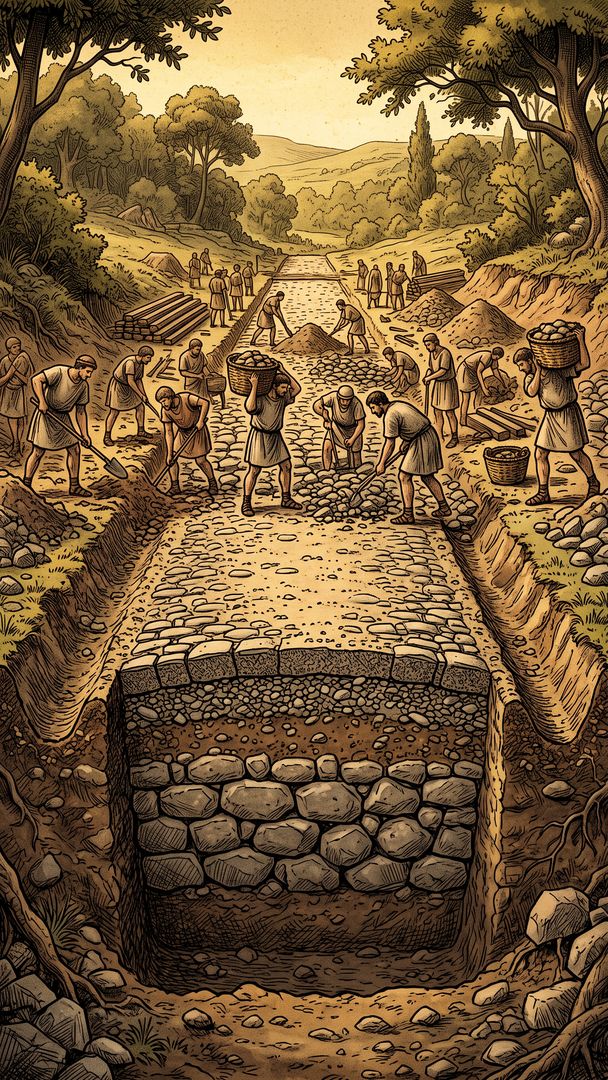
A typical Roman road was built in layers. Ditches either side, a raised bank called an agger, then stone, then packed gravel on top.
The top was cambered, curved like a turtle's back, so rain ran off into the ditches.
Why so straight? Surveyors took the most direct line, but where hills got awkward, the road simply bent.
From Lincoln to Ilchester, the Fosse Way is said never to stray more than about 6 miles from a straight line.
Watling Street ran from the Kent coast through London to Wroxeter. Its name came later, from the Anglo-Saxons.
Roughly every Roman mile, 1,000 paces, stood a milestone. Near Vindolanda, one still stands.
Long stretches of the modern A5 still run along old Watling Street.
One to keep: the word street comes from the Latin strata, a paved road. Say street, and you're speaking a little Latin.
Close the book. Keep your nose to the wind.
Sources
- The Roman invasion force of AD 43 landed in Kent, at Richborough, with road builders following the army; the roads were built first to move troops and supplies (English Heritage, 'How to spot a Roman road'; Britain Express).
- Estimates of the network's length vary: about 2,000 miles of main highways, and nearer 10,000 miles including lesser roads (English Heritage; Roman Roads Research Association).
- A typical Roman road had ditches on each side and a cambered mound of foundation stones topped with compacted gravel; roads ran straight in sections, adjusting for hills and rivers (English Heritage, 'How to spot a Roman road').
- The Fosse Way between Lincoln and Ilchester runs for about 180 miles and is never more than about 6 miles from a straight line (Wikipedia, 'Fosse Way'; Bristol and Avon Archaeological Society).
- Watling Street ran from the Kent coast via London and St Albans to Wroxeter, its name coming from the Anglo-Saxon name for St Albans, and the A5 follows long stretches of it (Encyclopaedia Britannica, 'Watling Street'; SABRE Roads, 'A5').
- A Roman mile was 1,000 double paces, about 1,480 metres, and a Roman milestone still stands beside the Stanegate near Vindolanda fort (English Heritage; Historic England, list entry 1014820).
- The word 'street' comes from the Latin strata, 'paved road', and in Old English was used mostly for the great Roman roads (Online Etymology Dictionary, 'street').
Spotted a mistake? Tell us in the YouTube comments and we'll correct it.